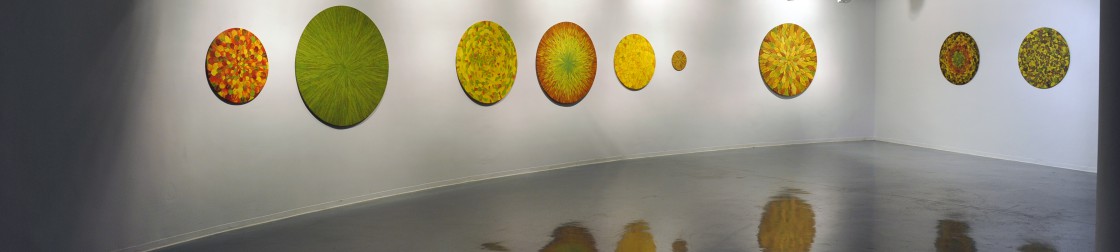
FORREST PLAYGROUND, Ivan Grohar Gallery, Škofja Loka, 2015
Forest Playground is conceived specifically for the space of the Ivan Grohar Gallery and is a conceptual and an interactive platform simultaneously. This is the artist’s very personal reflection of experiencing the structure of our common environment, which is particularly reflected in her systematic, yet very subtle recording of impressions and images from nature, as well as the documentation of her interventions into natural settings. By doing so, she preserves their memory and also discusses the significance of being aware of their transience. She then leaves it up to the viewer to further activate the work. To this end, she has devised a wooden puzzle where “her” images can be put together/apart in any desired sequence within its modular system by the viewer, whereas her animated booklet or flip book allows us to revive the “trapped/frozen” bygone scenes through the sense of touch. In such a way, we can propel time forwards or stop it, turn it back or to the future. With this approach, the artist brings to the set-up the necessary element of processuality that actually gives meaning to the basic story of her projects. It offers the possibility of manipulation so that we can influence the course of events within the embrace of the artistic installation, which would not be possible in real time and space. This is therefore an artistic statement, which on the one hand exposes the vanitas, the way it “ruthlessly” leaves a trail on the ground and everything that springs from it, and on the other hand elucidates the author’s romantic flight in the face of the “ravages of time”. The free path of imagination offered to us by the artist consequently leads us to reflect upon and seek answers to many of our own questions about the course of constant change, which is the only constant fixture of our existence.
If we were to seek the parallels to the work of Mateja Kavčič, we could certainly not bypass the main protagonist of her projects, which can also be found within the context of similar poetics, in the work of France Mihelič. The artist also places the tree in the forefront of her stories, its bark, leaves, fruits, moss. She discloses its vulnerability as it is overgrown by time, and at the same time the vital power by which it resists this, becoming like a pillar through which the juice of life flows. This is probably not a coincidence, since both are linked to Škofja Loka and both had the opportunity to directly experience the picturesque beauty of its landscape, which has visibly underlined the visual world of both artists. Otherwise, nature as such, its complex and inspiring world of matter and energy, has always fascinated artists, who look to it again and again for answers to many questions. It has imprinted itself into many images, it has influenced many visual languages, but it seems that artists’ interest for it today only continues to grow within the contemporary art practices. Especially since the boundaries of art are outgrowing their former strict limitations, merging with science, sociology, ecology, politics, etc. in multi disciplinary ways. Thus nature sometimes also acts as an idealized, dreamt and illuminated image, as we know it from romantic, Arcadian scenes and impressions (e.g. Anja Jerčič, Vesna Čadež, Metka Kraševec, Katja Sudec, Joni Zakonjšek). Elsewhere again, it is more dramatic and expressive, caught in the moment as it loses its colour, rots, pales, decomposes and darkens (e.g. Gegič Mito, Tina Dobrajc). And it is precisely somewhere here in-between that the art-ist’s reflection resides. The theme of nature is also popular in the context of ecological concerns, var-ious survival tactics, biology, social and pseudo-scientific fields and is manifested in more conceptual form (e.g. Boštjan Kavčič, Jože Barši, Boris Beja, Polona Tratnik, Maja Smrekar, etc.). Mateja Kavčič does not encroach upon this field (for now) and continues to remain an “incorrigible” romantic.
Barbara Sterle Vurnik
 Mateja Kavčič, slikarka