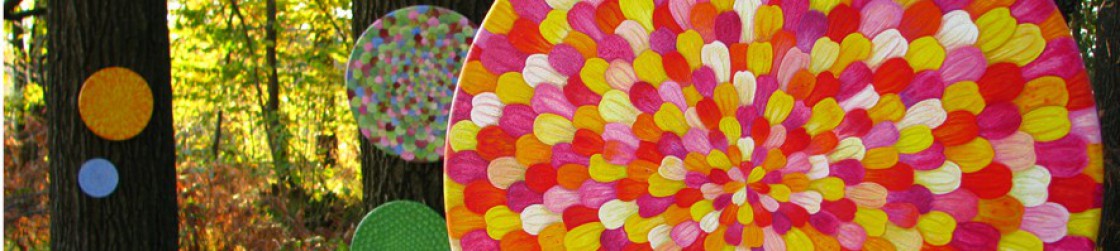
SHELTERS, Božidar Jakac Art Museum, Kostanjevica na Krki, 2016
The creative opus of the academic painter Mateja Kavčič has been permeated with nature from its very beginnings. When she started off she interpreted nature through classic painting in which the organic order stepped into the forefront. However, the order remained saturated on the painting surface, for the inner tension could be felt regardless of the formal and accurate geometric shapes. It was merely a question of time and artistic development when she would step across the threshold of the frame and enter the space through the canvass, i.e. step from the gallery space into nature. Her approach is primarily strictly ethical, for her work does not attempt to exploit nature; on the contrary, she shows great respect for nature. She pays attention to the changes in nature’s rhythm and cycles. Her work is extremely sensitive and in harmony with nature. One could say she leads a dialogue with nature.
Of course, these parameters also represent the rough starting points for land art that emerged at the break between the 1960s and 1970s as a response to the expansion of consumerism and the irresponsible treatment of natural resources in the interest of capital. Not even the world of fine art in which the postulates of market economy begun to dictate exhibition policies could resist this. The withdrawal from galleries and into nature was a protest by the young generation of the period, which found the idea for this in the concepts of avantgarde movements such as Bauhaus and later on the innovative pedagogic teachings at the Black Mountain College, where the relationship with nature was placed into the forefront. During the seventies the electronic media boomed and this lead to globalisation, which meant that this discourse occurred simultaneously in Europe as well as in Slovenia, and one of the first artists we should mention at this point is Marko Pogačnik and the collective OHO. Through Forma Viva, the international symposium of sculptors at Kostanjevica na Krki we got acquainted with this artistic expression relatively early. The park of sculptures still houses the 1974 work by the Austrian artist Karl Kessler, which is perforated with environmental issues, and the early 1980s work Organic Technology by the Canadian artist Carl J. Ciesluk. Later on several similar attempts also took place in the Božidar Jakac Art Museum, some in the form of pedagogic actions carried out by Mateja Kavčič.
This time the concept of the exhibition formally stepped away from the starting points of classic land art, for the artist and her installation with elements of nature have moved from the exterior into the exhibition space. The exhibition space is not a modernistic clean white cube, but a space filled with archaic elements, thus the artist had to sharpen her dialogue also with the space itself. In order to achieve the ever important harmony, the artist covered the floor of the exhibition space with small pebbles, which functioned as a base and a conductor between the interior and exterior. The story that the artist has imaginatively placed into the exhibition space is full of symbols and intuitive fragments, as well as references to the history of land art. The concept of the exhibition, which is determined already by the title Shelters, is of course not intended merely for itself and the immanent aesthetic component, but also encourages and inspires interaction. This interaction is not limited merely to the visitors, but also spreads to the expressed essence of the natural elements in space, as well as the potential beings that coexist with these elements. These can be either representatives from the animal or the fairy, magical world. Shelters are always constructed for somebody. Maybe this is why the exhibition brings to mind the painting worlds that Hieronymus Bosch could come up with and about whom we have been talking this year a bit more as it was the 5th centenary of his death, but even more Mateja’s exhibition reminds me of The Fairy Feller’s Master-Stroke, the small but extremely important painting by the controversial Victorian English painter Richard Dadd. This work has been written about and interpreted by many, amongst others the Nobel Prize winner Octavio Paz, Neil Gaiman, and has been sung about in a song by the British rock group Queen. This is an exceptionally multilayered work which reveals additional layers with every glance. At first glance you might see merely grass stems and daisies, but in the end you will see the entire universe. We can witness a similar situation in Mateja Kavčič’s exhibition, for in her site-specific project she used predominantly natural local material found in the vicinity of the gallery. A path paved with fern cocoons leads us into the first room. According to folk beliefs fern has magical characteristics. On St. John’s Day or midsummer night fern seeds help us obtain special powers with which we can understand the language of animals. Fern thus functions as a mediator of perception. Through associations it leads us into the forest, a space ascribed a special meaning in numerous mythological beliefs, a place where many divinities are worshipped. In the corner at the end of the room stands the largest fern cocoon, which lures us into it. It lures us into a magical world, where nothing is the same, where rational measurements give way to child’s intuition. We find ourselves in a nest (one could say literary) and we understand it as such, as a metaphor of birth, home and economy. The nest is an established motive in the history of land art and we can understand this creation as a homage to one of the more visible artists in this field, the British artist Andy Goldsworthy. A similar homage can be seen in the next room, where we come across a long braid weaved from grass, with a twisted spiral in its centre. This is reminiscent of the work Spiral Jetty created in April 1970 by one of the fathers of this art form, the American Robert Smithson. Of course, the spiral is symbolically extremely important, for it depicts spiritual growth and development and is a symbol of eternity. In this mythological interpretation of the work many will recognise the links with the Grimm brothers’ story Goldilocks, for the braids stretch like octopuses throughout the space, through the windows and openings, they seep through and reach out, into nature.
The rooms are connected with filigree drawings, created on the wall in charcoal. They include the motif of tree leaves, and we can recognise the leaves of the mighty oak tree, which is of special importance for our space and the Forma viva activities. Its importance can also be seen in Slav mythology, for the Slavs imagined the world as a great tree, usually an oak. The branches and the trunk represented the living world, while the roots represented the world of the dead. Of course, the choice of the drawing tool was well thought out, for charcoal is an organic derivative of a tree. As we stroll through the labyrinth in the lapidary, past the floating floral wreaths and grass that grows in the downwards direction, we come to the last room. In this room we pass cocoons that are similar to the ones we have encountered in the first room, only this time they are made of straw, and they lead us to the large stack of hay which lures us to lay in it. From this perspective the world is seen in a completely new light. Some may think that they have dreamt it all, while others will continue their path to the dreams. They might even meet somewhere along the way. The horizons are broad and there is plenty of room for all travellers.
Goran Milovanović
 Mateja Kavčič, slikarka